
Eating the Wild
plant medicine and the Communion of the Wild Redeemer

Eighteen years ago this June, I sat across from Stephen Buhner as he and Julie McIntyre began to teach the way of navigating the world through the perception and intelligence of the heart. He began by saying:
“You must understand — I am a barbarian.”
And before you read further, you must understand that on that I too have become a barbarian. I am not civilized — I am not of the cities.
The cities are the places walled off from the rest of the living world — from the Greek city-states to imperial Rome to the English Pale to the fences of the enclosures to gated communities. (Though wild things always come through the cracks in their walls and foundations.) Those who live beyond the walls, beyond the Pale, speak in barbarous tongues that echo the calls of Wolves and Raves and the sound of the wind in the Pines.
In some ways, I never was civilized. Nevertheless, I had tried to be. I had come to the workshop a few weeks after quitting my job working for a nonprofit in Boston that was amplifying the voices of people whose loved ones had experienced the horrors of the wars in Iraq and Afghanistan. I had been broken open by their stories in the same ways I had been broken open by the stories of the people I had met in Oaxaca and Colombia and Bolivia and El Salvador and Nicaragua and in American jails in the decade I had spent dedicating myself to opposing and resisting the wars being waged in my name. And I was beginning to come up against the reality that I had not yet understood — that my brain is one that moves not from task to task in the mode of a political organizer but in long, fractal, riparian flows that begin somewhere in the ancient past and wash around and past and sometimes over and sometimes through the borders of the assumptions that make up the unwritten rules of society and its perception of reality — that to make political change within this culture, you need to be of this culture, and I never have been.
So I had gone into the mountains and fasted. And the Usnea lichen had come to me and worked its way through the cracked places in my heart and awoken something green in me that was not able to return to the city, to the office, to any part of the life I had been living. And then I found myself in Vermont, sitting across from Stephen, who looked right at me when he said:
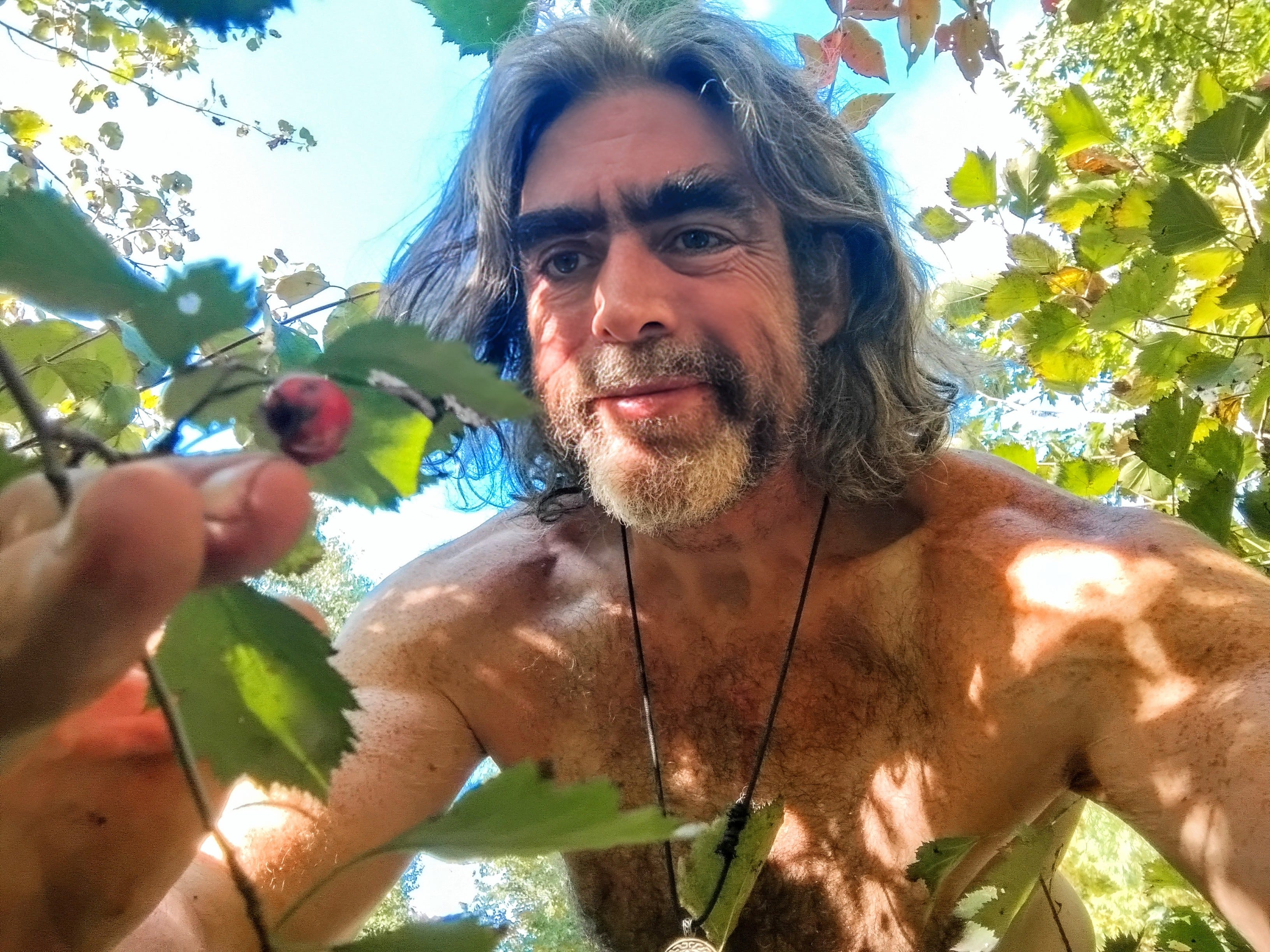
“If we eat the wild, it begins to work inside us, altering us, changing us. Soon, if we eat too much, we will no longer fit the suit that has been made for us. Our hair will begin to grow long and ragged. Our gait and how we hold our body will change. A wild light begins to gleam in our eyes. Our words start to sound strange, nonlinear, emotional. Unpractical. Poetic.
”Once we have tasted this wildness, we begin to hunger for a food long denied us, and the more we eat of it the more we will awaken.”
I had encountered these same words a year and some month before, reading Stephen’s The Secret Teachings of Plants in a pizza shop in Bangor, Maine. And I had gone back to them again and again, savoring the way they tumbled around inside me,
But when he spoke them, something luminous flowed, and it entered through the same cracks in my heart that the Usnea tendrils had — and my soul rejoiced, while my rational mind said “You bastard! I thought it was a metaphor!”
(And if a metaphor is a bridge between worlds, maybe it had been a metaphor. But once it had carried me across the river, I looked behind me, and the bridge was gone.)
I understood something important then: this is why wild medicines come to us — to open the way for the rewilding of our beings.
If the Hawthorn also nourishes my heart, if the Skunk Cabbage also clears the muck from my lungs, if the Psilocybin also helps me let go of the depression and trauma that have plagued me, these are merely beneficial side effects. It all ultimately serves to bring me to my senses so I can come back into communication with the living world and begin to bring life back to the ways of living in relation with Oak and Bear and mountain and river and stars that are not only my birthright, but the necessary condition for humanity to live as anything other than a cancer within the Gaian organism.
Note the distinction I am making here: humanity is not a cancer. Civilization is the state in which the cells which are humanity behave in a cancerous way. Edward Abbey wrote “Growth for growth’s sake is the ideology of a cancer cell.” The ideology is the disease pattern, the populations it moves through are the tissue which becomes diseased.
The living medicines of the plants and mushrooms and lichens that I ally with are in mycorrhizal relationship with the Wild Redeemer. To redeem is to take back. The Wild Redeemer reclaims human hearts in the same way that Nettles and Blackberry and Mugwort reclaim fallow fields and abandoned orchards.
The Wild Redeemer is himself a mythic rhizome that runs through history erupting through the concrete of civilization, bringing forth expressions of resistance, liberation, and renewal. In the time of the Greek city states we find him coming in the shapes of Dionysus and Pan. In Roman occupied Palestine we find him in the radical vegetal Jesus, executed by empire for the crime of reminding people of the cycle of life, death, and rebirth by resurrecting Lazarus and threatening to rob empire of the threat of murder that underlies its ability to coerce compliance. (Resurrection is a magick every culture and every species performs, it just usually involves leaving your identity behind and growing another body.) After the Norman conquest in England he found expression in the figure of Robin Hood, ungovernable hunter of the wildwood who robbed the people who robbed the land. In Nottingham, centuries later, he came as Ned Ludd, rallying the people against the emerging Industrial Revolution in the wake of the Enclosures. In the West of Ireland, a generation earlier, he had come in the form of a Buachaillí Bána who launched raids on landlords and their agents. In the 1940’s, the rhizome worked through Albert Hoffman to derive LSD-25 from Ergot and send it out into an Earth-destroying globalizing civilization. The dominant culture attempted to contain LSD in controlled environments, but in the ultimate lab leak, it found its way out through the mind and body of an experimental subject named Ken Kesey (the vector of transmission by which it would reach a young Stephen Buhner in San Francisco and bring him into the direct presence of an Elder of Earth.) In the 1980’s the Wild Redeemer rose again in Earth First!, and at the dawn of this millennium found new expression in Zapatismo!
To eat the wild is to partake in the communion of the Wild Redeemer.
The only blasphemy possible is to refuse to be transformed.
—
The making of meaning is always a meitheal — a collective work party. Writing, I am immersed in a chorus of voices, human and wild, of this world and the Otherworld. It is important to name and give gratitude to the voices in that chorus I can discern so that other can invite them into their own meitheal:
Sophie Strand has done so much to advance animist/ecological/mycorrhizal understandings of myth — her speaking of mythic events as ecological events, the mycelial nature of stories and heroes, and especially of the mycelial/rhizomatic nature of the connection between Dionysus and Jesus was definitely an important part of what helped me see the nature of the mythic rhizome that is the Wild Redeemer.
All modern discussion of the rhizomatic of course are expressions that trace back along one rhizome to another to the work of Gilles Deleuze and Félix Guattari fed my the mycelium of radical thought that ran through the cultural soil of France in the late 1960’s. And of course they, and especially Guattari, derived their understand from the rhizomes themselves.
My understandings of Jesus and empire owe much to Liberation Theology and to the Catholic Worker movement. The understanding of the resurrection of Lazarus as the event that potentially disarmed empire and brought on the death sentence imposed on Jesus comes from the Queer Episcopal lay theologian William Stringfellow.
The naming of the Wild Redeemer comes from Dale Pendell. And of course from the Wild Redeemer.
Everything I know about the mycelial I learned from Psilocybe spp.
Echoing through my consciousness all week leading into writing this have been conversations with a dear one as well as talks on the Trickster she guided me to by Lewis Hyde, Josh Schrei, and Bayo Akomolafe. And I can’t invoke Trickster without invoking my dear friend Caroline Casey who lives and breathes Trickster.
And gratitude to Megan Kaun for reminding me of the importance of naming these voices.
And gratitude to the voices in the chorus I have not named.
—
This coming Sunday, May 24, I will be giving an online class on Robin Hood, Ned Ludd, and the Wild Redeemer.
__________________________
I rarely paywall articles or poetry here, and am unlikely to start doing so with any frequency. All are welcome to the free material here — and if you have a little money to redistribute, your spending some of it on a paid subscription or on a class or consultation with me would be greatly appreciated — especially in a time when more and more of those my work does connect with cannot afford to pay. You can also make a gift through https://buymeacoffee.com/seanpadraigodonoghue
Sharing my writing with others also helps me in this work. So does suggesting that your favorite podcast invite me on as a guest.
I am currently trying to carve out time to complete the manuscript for my next book — Rewilding Psychedelics — your support right now would help me do that.
We all need to feed our wild inside. Love your essay. I am between the two worlds ATM. One foot in (the city) the other out in (the wild of the land, and for me, as a thalassophile, the sea). It's a battle :) Gaia's calls are so soft in amongst the busy noise. And yet they are all I hear.
Thank you for this. Just wanted to share I'm making a collection of upcycled linens right now with hand- printed images of the spirits of Nettles, Blackberry, and Mugwort. The collection is called "Hedgerow," inspired by the threshold between civilization and Wilds. Small, sweet, vast world.